Category Archives: Arts Friday

Arts Friday | The Impact of Cinema in Pre-Pandemic Times

watching-movies.jpgNostalgia for a Time When Going to the Movies Was a Pleasure We All Enjoyed
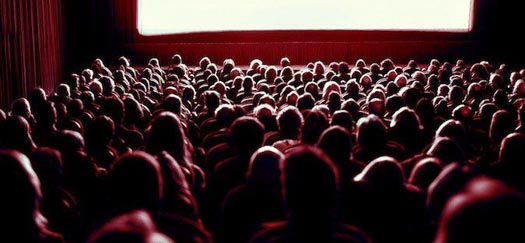
Each and every one of us possess within us memories of our experiences visiting the cinema: as a child of attending at the movies with our parents; our first foreign or independent film with a group of friends; or simply visiting our local multiplex cinema to catch the latest superhero blockbuster, or making the pilgrimage to one local film festival or another.
Pre-pandemic, going to the movies was still a popular past-time, even in an age when media consumption and “film viewing” has radically changed (think of the Netflix revolution). In North America in 2019, there were 1.3 billion cinema admissions — a not-insignificant, nor surprising figure.
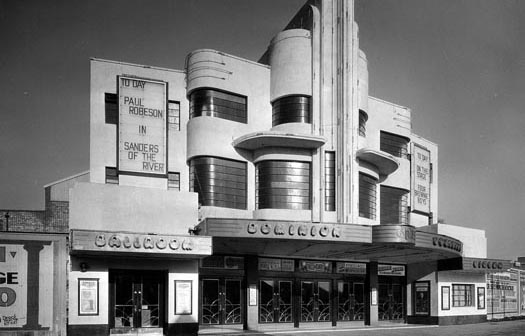
An art deco cinema in the 1930s

In 1930, more than 65% of the population went to the movies weekly. That means for every 5 people you knew, 3 of them went to the movies weekly.
Can you even imagine that?
Eighty-five years ago, cinema-going remained astoundingly popular across the continent, reaching a peak of 1.64 billion admissions in 1946 — even though the North American population was less than half of what it is today.
Why was cinema so popular in times past?
Some of the reasons are fairly straightforward: there was limited opportunity long ago for inexpensive recreational activities outside of the home, television had yet to assert its power, and film was an established medium which exposed millions to different worlds and alluring cultures (or, more often, to the vicissitudes of North American culture).
There was, however, a deeper and perhaps more fundamental reason for movie-going’s immense popularity in North America mid-20th century.
Recent research on movie-going habits in the twenty and 21st centuries has focused on the interplay between space and emotion, and how cinemas act as facilitators of emotional experiences in ambiguous spaces.
Over the years, movies have aided people in helping to reveal new insights into their lives, while allowing a better understanding of the lived experiences of people across the globe, and in their own neighbourhood. Cinema has not only traced our conception of life, but has also served to affect our outlook on life and the lives of others.
Watching a film in the presence of others is different from watching a film alone, or with our family: the collective constellation affects the way viewers experience a film, made all the more obvious once strong emotions and affective expressions come into play: laughter, sadness, shame, anger, screaming, and more often than not (if we’re lucky) being moved to tears.
Different times in history — and different spaces — have served to create new affective landscapes and altered existing ones, making cinema a useful category for historians to study changes in society and culture over time.
The history of cinema has been integrated alongside other sociological methodologies to help form a more refined and complex picture of the past, and in consequence has offered a valuable way of introducing new insights into the establishment of popular culture, and societal development.
The darkness of the cinema environment presents the opportunity to experience a strong shared emotional experience in a public setting, in the anonymous environment of the auditorium. No other public space has facilitated this to such a degree, and this uniqueness reveals how the life of our society developed in specific contexts and in precise locations.
The enclosed and defined space of the cinema auditorium, containing a distinct group in the form of an audience, is an obvious example of community. Patrons in the cinema are aware of both their own emotional response to what they are viewing onscreen, and the feelings of those around them, providing reassurance that our emotional responses to a film are being mirrored by our fellow patrons.
Respected film critic Leslie Halliwell recalled in his memoir on cinema-going that film took “people furthest out of themselves, into a wondrous and beautiful world which became their Shangri-La”.
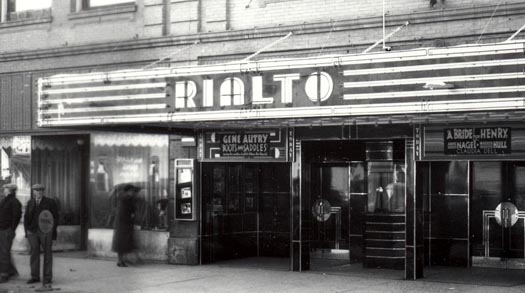
the-rialto.jpg

This utopia was reflected in the very names of cinemas — the Orion, the Rialto, the Plaza, the Regal — and in the architecture of the buildings which encompassed a range of styles including the clean lines of Art Deco and the high theatrics and excess of the “atmospherics”.
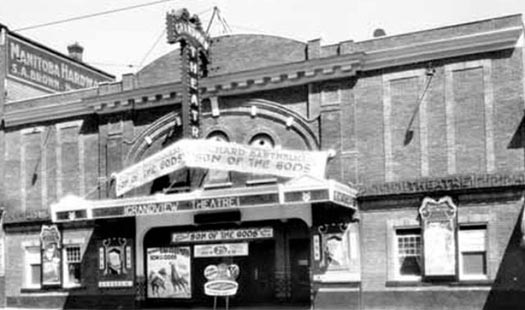
The Grandview Theatre, Commercial Drive at East 1st Avenue in Vancouver, in the 1950sThe Grandview Theatre, Commercial Drive at East 1st Avenue in Vancouver, in the 1950s

Evidence suggests that many people viewed their local movie-house, whether a stand-alone, second-run neighbourhood movie house or a first-run super-cinema, as a reassuring and familiar space characterized by a hazy emotionality fluctuating between the individual and the group, in the process offering a sense of connection with those who surrounded us.
This ambiguity — the individual vs the collective experience — lies at the heart of what attending at the cinema signifies to people. In few other areas of life are the landscapes of our lives softened to such a degree, in turn making attendance at the cinema a welcoming experience.

cineplex-cinemas.jpg

Cinemas have long occupied a position on the boundary between the domestic and the public, allowing our emotional experience of a movie concurrently as both communal and private, the evolving emotional landscapes which were crafted by cinema patrons in the mid-20th-century serving to break down anomie while creating a sense of connection.
The fundamentals of our affective experience at the movies has changed little over the past 100 years.
The price of popcorn, however, most definitely has.

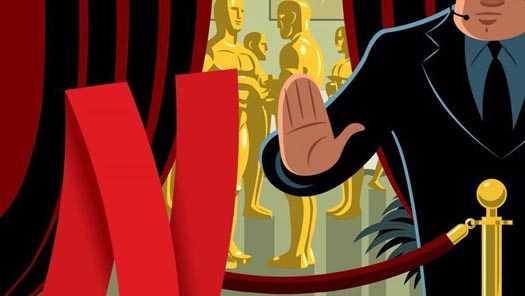
Arts Friday | Netflix Takes Over the Oscars in 2021

Netflix to overtake the Oscar ceremony in 2021

In 2019, Netflix landed its first Oscar nomination for Best Picture with the release of Alfonso Cuarón’s critically acclaimed Roma. A year later, the streaming service was leading the field with 24 Oscar nominations, including Best Picture nods for both The Irishman and Marriage Story.
As Netflix’s impact on the world of cinema became increasingly undeniable, the younger and more diverse film academy was no longer prepared to shun the streaming service as the old Hollywood guard tried to do. Earlier this year, on April 28th, responding to the changes that COVID-19 had wrought, the Academy of Motion Picture Arts & Sciences removed the stipulation that a movie must be shown in a theatre before it could become eligible for the coveted Best Picture Oscar nomination.
And thus the stage was set for an Oscar ceremony in 2021 the likes of which no one will have ever seen before, with at least seven Netflix releases eligible for a Best Picture nomination, with each of those films set for Oscar nominations, ranging from Best Actor and Actress, Supporting Actress and Actor, to Best Director, Music, Sound and technical awards.
Today on VanRamblings, the Netflix features set to dominate Oscars 2021.

For the upcoming Academy Awards — delayed due to the pandemic until Sunday, April 25th — Netflix has pulled out all the stops. Already streaming, there’s Spike Lee’s Best Picture contender Da 5 Bloods, Gina Prince-Bythewood’s well-mounted action thriller The Old Guard, and Charlie Kaufman’s screenplay contender, I’m Thinking of Ending Things.
And, available today on Netflix, there’s writer-director Aaron Sorkin’s The Trial of the Chicago 7 which is, as Variety lead critic Owen Gleiberman writes, “a knockout, and the rare drama about the 1960s that’s powerful, authentic and moving enough to feel as if it were taking place today, a briskly paced and immersive film bristling with Sorkin’s distinctive verbal fusillades, a cinematic powder keg of film with a serious message that seamlessly blends a conventional yet compelling courtroom procedural with protest reenactments and documentary footage, the film offering an absorbing primer of a ruefully meaningful period in American history.”

Due to arrive on Netflix on Tuesday, November 24th — on the eve of American Thanksgiving — director Ron Howard’s big budget film adaptation of J.D. Vance’s autobiographical best-seller, Hillbilly Elegy offers a powerful account of growing up in a poor Rust Belt town, that also provides broader, probing insight into the struggles of America’s white working class.
A passionate and personal analysis of a culture in crisis, Glenn Close and Amy Adams are at the centre of Howard’s film, and solid prospects for Best Actress and Best Supporting Oscar nods. Howard will be in the mix, as well.

Netflix will release David Fincher’s Mank in select theatres in November before the black-and-white film begins streaming on December 4th.
The Hollywood-centric period piece follows alcoholic screenwriter Herman J. Mankiewicz (certain Best Actor nominee Gary Oldman) as he races to finish the screenplay for Orson Welles’ 1941 masterpiece Citizen Kane. That classic picture was fraught with behind the scenes drama, as Mankiewicz and Welles argued over credit and who wrote what, which became even more important once the film won the Oscar for Best Original Screenplay.
The original script for Mank was written by Fincher’s father, Jack Fincher, so this project certainly means a lot to the filmmaker. Mank boasts a running time of 2 hours and 11 minutes, so it won’t be quite as long as Zodiac or The Curious Case of Benjamin Button, not that Fincher ever wastes a single frame. The film is expected to be a major awards contender for Netflix.

Ma Rainey’s Black Bottom. George C. Wolfe directs, Denzel Washington produces, and Oscar-winner Viola Davis (Fences) stars as Ma Rainey in Ruben Santiago-Hudson’s adaptation of the hit August Wilson Broadway play. The late Chadwick Boseman and If Beale Street Could Talk star Colman Domingo play members of Rainey’s ’20s jazz band.
Awards prospects: Ambitious trumpeter Levee was 43-year-old Boseman’s final role before succumbing to his private battle with colon cancer in August; he looks rail thin in film stills. Posthumous Oscars went to Heath Ledger (The Dark Knight) and Peter Finch (Network) among others. In this case, with the beloved Black Panther star also in the running for his supporting role as a U.S. Army soldier in Vietnam in the Spike Lee joint, Da 5 Bloods, many believe that it’s likely Boseman will wind up in the Best Actor category for Ma Rainey, with Davis as Best Actress. Like Mank, the elaborate period setting should be attractive to Academy craft branches.
Release date: In theatres early December, streams on Netflix December 18.

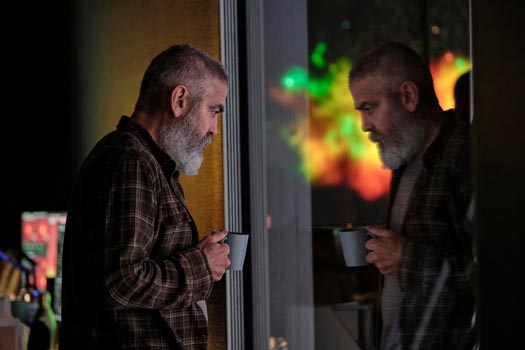
The Midnight Sky, director-star George Clooney's new sci-fi film for Netflix

Oscar-winner and Hollywood icon George Clooney directs The Midnight Sky, a sci-fi thriller with a script by Mark L. Smith (The Revenant) based on the Lily Brooks-Dalton novel about an Arctic scientist (Clooney) attempting to warn a NASA spaceship astronaut (Felicity Jones) not to return to doomed planet Earth. Awards prospects: Netflix took advantage of the London Film Festival this month (October 2 – 18) with a tribute to Clooney, complete with clips. Critical reaction will determine whether The Midnight Sky will figure in the Oscar sweepstakes, but Clooney (Syriana) has delivered in the past, as has Oscar-nominated Jones (Theory of Everything).
Release date: In theatres early December, Netflix début to be announced.

VIFF 2020 | You Have Less Than One Week to Stream VIFF Films


Tracey Deer's new film on 1991's OKA crisis, Beans, awarded Best Canadian Film at the 2020 Vancouver International Film Festival

Click or tap on the picture above to access the trailer for Tracey Deer’s new film, Beans

Flat out VanRamblings’ favourite film at VIFF 2020 — along with Jennifer Abbott’s new documentary, The Magnitude of All Things — writer-director Tracey Deer’s new film, Beans, is a poignant, wrenching, heartrending, gut-punch of a film, the first narrative feature to focus on 1991’s Oka Crisis on Québec’s Kahnawake reserve, the story told through the eyes of a 12-year-old girl (the ‘Beans’ of the title) whose family, friends and neighbours lived through the violent 78-day conflict on Mohawk land, with young Kiawentiio embodying, with beyond-her-years wisdom, and forceful determination, director Deer’s own experience as a young girl. An absolute knock-out of a film that had me in tears throughout, and as I say above, a must-see.
VanRamblings’ review of The Magnitude of All Things may be found here.

Another film that has emerged as one of VanRamblings’ favourites is the Serbia/Croatia/Slovenia/Bosnia and Herzegovina co-production, Father, about which Taste of Cinema’s David House writes

unsettling, a bleak and heartbreaking tale of the struggle of a father, Nikola, to regain custody of his children from a corrupt Serbian bureaucracy determined to separate the children from their family. With a powerful, quiet, understated, award-worthy performance from Goran Bogdan as Nikola, whose love and devotion to his family emerges as a drama of tender devastation, that tells its story with an unblinking neorealist simplicity redolent of the plainspoken purity of Vittorio De Sica.

In addition, Father offers a damning critique of an uncaring Eastern European government, as well as a rallying cry for those who fall through the cracks. A film filled with gentle humanity, and an unquenchable decency, courage and perseverance, Father is a spare, unadorned film, with as touching a story as you’ll see at VIFF 2020. Recommended.
More Taste of Cinema VIFF 2020 reviews may be found by clicking here.

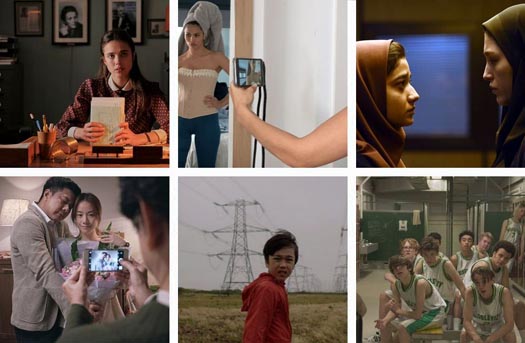
VIFF 2020 film reviews by Jason Chen, in Kaleidoscope online arts & culture magazine

Finally for today, a few VIFF 2020 reviews written by Kinetoscope film critics, the acclaimed Jason Chen and Robert Snow.

My Salinger Year | Opening night film Berlinale 2020 | Kinetoscope review by Jason Chen

My Prince Edward | Best New Director Hong Kong 20 | Kinetoscope review by Jason Chen

The Reason I Jump | Audience Award, World Documentary Competition, Sundance 2020 | Kinetoscope review by Robert Snow


A Life Turned Upside Down: My Dad’s an Alcoholic
| Kinetoscope review by Jason Chen

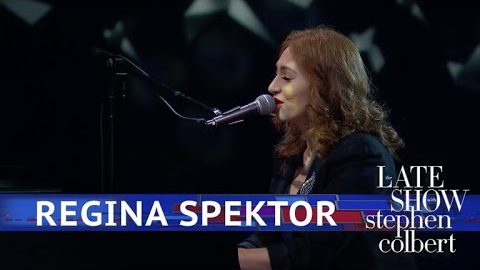
Music Sundays | Regina Spektor | A Cinematic, Tender Storyteller

Celebrating the music of Regina Spektor

Some years ago, as I have written previously, my friend J.B. Shayne was in my home, and scanning my vast CD collection (we’re talking the early ’90s here), he commented, “Do you realize that 80% of your record collection features female vocalists?” In fact, the percentage of female singer-songwriters in my music collection is probably closer to ninety per cent.
Today, I present a couple of songs from my iTunes / Spotify music collection by artist Regina Spektor, who although she hasn’t achieved the mainstream success of a Fiona Apple or a Tori Amos, nonetheless deserves much more recognition for her weighty, low key 19-year career than it’s earned to date.
Whimsical, with great melodies and brilliant songcraft, Regina Spektor’s music is simply beautiful, both lyrically and musically, with an almost angelic quality to them, showcasing always her distinctive vocals and winsome piano talents, a storyteller of the first order, a singer-songwriter brimming with personality, and more than capable of conjuring up moments of wisdom, maturity and magic, in a career deserving of celebration and recognition, that is uniquely — and unmistakably — hers and hers alone.

star.jpg star.jpg star.jpg

Samson was initially recorded as the first track for Regina Spektor’s second album, Songs, which she recorded in one take on Christmas Day 2001. In 2006, Ms. Spektor re-recorded the song for her album Begin to Hope, which, unlike Songs, had a major label backing. And, the rest is history.

Regina Spektor’s best songs tweak inviting melodies with bits of eccentricity in rhythm and vocal cadence, resulting in music that skilfully hits emotional buttons without coming across as formulaic. Laughing With, which was the first single released from her fifth album, Far, doesn’t quite play to those strengths, but instead opts for a modern balladry that is, as you will hear, ideally suited to our trying and most difficult pandemic times.