
Category Archives: Arts Friday

#ArtsFriday | Passing | Searing, Heartbreaking, Tragic Cinema | #Netflix


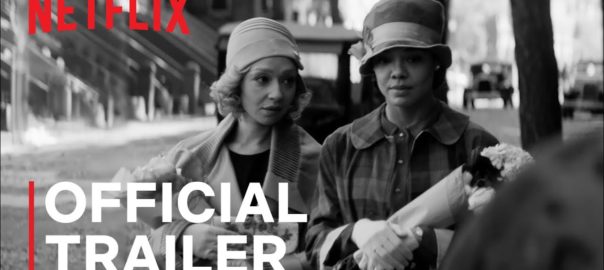
Début film by Rebecca Hall (left), Passing, stars Tessa Thompson (centre) & Ruth Negga

A complex examination of race and sexuality set against the backdrop of a 1920s-era Harlem Renaissance that celebrated Black novelist Nella Larsen captured in her seminal 1929 novel, Passing, marks British actress Rebecca Hall’s assured feature directorial début — a certain 2022 Oscar contender, having taken New York by storm last month at their annual New York Film Festival, and already up for a passel of Gotham Awards — will be available on the Netflix streaming service this coming Wednesday, November 10th. “We’re all of us passing for something or other, aren’t we?” muses Tessa Thompson’s melancholy character, Irene Redfield.

Ms. Hall’s choice of material for her début as writer-director is elevated by her evident personal investment in the story, having learned years ago that her American maternal grandfather was Black passing as white for most of his life. That intense personal connection pervades every lovingly composed shot of a work that takes a subtle, unwavering approach to the film’s subject matter, that resonates at a moment Black Lives Matter has exposed the simmering racial divides within society.

The story takes place in 1929, as Harlem resident Irene (Thompson) carefully navigates her way through a sweltering New York City summer day, tucking her face inside her hat so as to all the better, well, maybe not hide exactly, but at least obscure her face so that her black skin isn’t as evident to the privileged white locals surrounding her. Feeling self-conscious about being out of place, she’s shocked to run into Clare (Negga), a school friend with whom she had lost contact, now married to a wealthy (and avowedly racist) white man, John (Alexander Skarsgård), who has no idea that his wife is black. Clare “passes” for white, allowing her entree into an upper-crust American society that contemptuously shuns people of colour.

Inviting Irene up to her hotel room, upon returning to her home, there’s a marked visual switch from Clare and John’s suite, an airy space drenched in white light, to the more textured look inside the Harlem brownstone where Irene lives with her doctor husband Brian (André Holland) and their two boys. The action flashes forward to the autumn, when a letter from Clare, postmarked New York, indicates she has moved back to the city as she had hoped. Irene is hesitant to open it, but Brian is more curious, arching his eyebrows at Clare’s florid description of “this pale life of mine,” as she gently chides Renie for exposing her “wild desire” for another life.

Shot in luminous black-and-white by cinematographer Eduard Grau (a choice that, given the material, might sound gimmicky, and is not), Ms. Hall also opted for a boxed-in 4:3 aspect ratio, all the better to heighten the film’s constant tension and the sense that its piercingly sad characters can’t escape the confines of their lives.

From the very first frame, Passing grabs your attention with its striking aesthetics. Most notably, as mentioned above, the desaturated black-and-white cinematography and 4:3 aspect ratio that recalls both vintage photography and classic cinema. The period-appropriate costumes and production design — stylishly rendered by the production designer Nora Mendism, and the costume designer Marci Rodgers — gives a strong sense of a time and place when flappers lived their best life. To add an elegant finishing touch, the intermittent piano refrain of Emahoy Tsegué-Maryam Guèbrou’s Homeless Wanderer, and the gorgeous score composed by Black composer Devonté Hynes, provides a further nostalgic nod to the Jazz Age.

Passing tingles through the vulnerability of Irene and Clare’s smallest gestures and experiences, delicately conveyed by Thompson and Negga and magnified by Eduard Grau’s judicious close-ups. A tear rolling down a cheek. The slight bow of a hatted head in the presence of a white man. A stolen glance of desire. Under the genteel mask these women show to the world lies a roiling unease about their true desires, their obvious and barely hidden secrets, and their place in the world.

And it’s through this discomfort that Passing transcends its mannered trappings to resonate with us as a poignant and powerful exploration of the human condition.
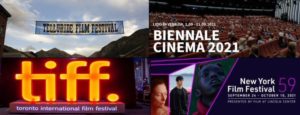
Arts Friday | The Much Anticipated Autumn Film Festival Season Underway

In 2021, wherever a film festival may take place, appropriate COVID protocols will be in place, including mandatory masks in the screening rooms and common areas, and proof that cinephile patrons have been vaccinated.

The pandemic – particularly given the ravages of the COVID-19 fourth wave – will probably mean, and has meant at the Telluride and Venice film festivals, prejudiced attendance numbers at fall film festivals. As was the case in 2020 – and once again will be so in 2021 – films on offer will be made available for home viewing, with a small number of films  available exclusively for in-person screenings. In other words, in order for film festivals to “work” in 2021, festival directors have adopted a “hybrid model” to satisfy the viewing demands of their loyal patrons.

At Telluride and Venice, major film studios made their star-driven, Oscar contending film slates available to these two prestigious film festivals, as will be the case in Toronto – which got underway yesterday – and later this month in Gotham City, at the 59th annual New York Film Festival, which will share half their slate with VIFF.

At Telluride and Venice, Hollywood stars turned out in all their finery, engaging in post screening discussions with audiences, sitting in rapt & appreciative attention.

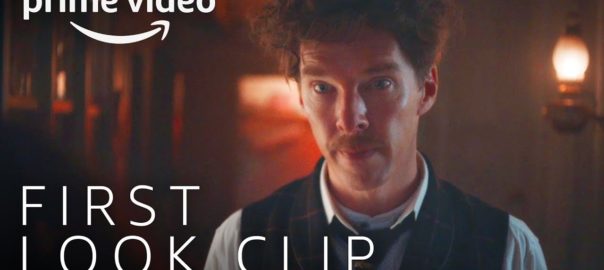
Above is a clip of Japanese-English director Will Sharpe’s The Electrical Life of Louis Wain, a whimsical Victorian biopic starring Benedict Cumberbatch and Claire Foy which, it was announced at the annual Vancouver International Film Festival media conference has been selected as VIFF40’s opening night film, on October 1st.

“Movies are a distraction from reality,” says a character in Paolo Sorrentino’s Hand of God — which débuted at Telluride a sprawling, funny-sad, autobiographical coming-of-age story. That’s a good thing. Reality is drab and painful — “lousy,” according to the film’s English subtitles — and film provides a much needed respite.

The break-out Oscar contenders that débuted at Telluride include …

Cyrano, a lovely new telling of the classic story of Cyrano de Bergerac, which had its world première at Telluride, and took that film festival by storm with guaranteed Oscar nods all around;

https://youtu.be/MUnsoxe7K4g

The North American première of Spencer, the mesmerizing new drama starring Kristen Stewart (a guaranteed Best Actress Oscar nominee) as Princess Diana; and

The crowd-pleasing King Richard, a drama charting the rise of tennis superstars Venus and Serena Williams, expected to launch Will Smith into the Oscar race for his portrayal of the girls’ demanding dad and coach, Richard Williams — a loving, egocentric father who, it turns out, did know what was best for his daughters.

Céline Sciamma’s exquisite Petite Maman — which débuted at the Berlinale, and has been set as VIFF40’s closing night film (cuz it’s VIFF programmer, Curtis Woloschuk’s, favourite film at VIFF this year, he told VanRamblings earlier in the week — don’t tell anybody, though, cuz it’s a secret) — a delicate film full of surprises. Sciamma, whose Portrait of a Lady on Fire was a VIFF standout in 2019 (at the pre-pandemic VIFF festival), examines female intimacy from a different angle.

Nelly and Marion (played by young twins named Joséphine and Gabrielle Sanz) are 8-year-old girls living in similar houses in the woods. They strike up a friendship tinged with elements of fairy-tale supernaturalism, magical realism and time travel. The twists packed into the film’s compact 72 minutes arrive gently and matter-of-factly. The intense emotions they leave behind — this is one of the quietest tear-jerkers you’ll ever see — are at once familiar and wholly new.

Soon, the sane and responsible among us will be fully vaccinated and in possession of our province-issued vaccine card — making attendance at movie theatres, restaurants, bars and pubs safer and more enjoyable for the vast majority of us.

As much as COVID’s fourth wave will keep us in its troubling grip, for the most part it is the anti-social unvaccinated amongst us who will bear the malignant brunt of the coronavirus — for the rest of us, a return to a near normal state of being holds promise for our immediate future, and the prospect of an autumn movie-going season sitting amongst our brothers and sisters inside a darkened movie theatre.

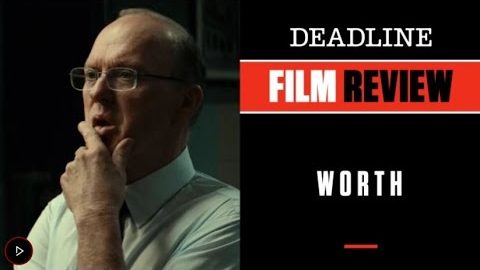
Arts Friday | Netflix Debuts ‘Worth’ Today

A week Saturday marks the 20th anniversary of the tragedy that was 9/11.

Sara Colangelo, the award-winning writer and director of the 2018 film, The Kindergarten Teacher, brought her latest film, Worth, to the Sundance Film Festival in January 2020, Now, some 19 months later, Netflix makes Worth available on their service — the film starring Michael Keaton and Amy Ryan.

Following the horrific 2001 attacks on New York City’s World Trade Centre and the U.S. Pentagon, Congress appointed attorney and renowned mediator Kenneth Feinberg (Michael Keaton) to lead the September 11th Victim Compensation Fund.

Assigned to allocate financial resources to the victims of the tragedy, Feinberg and his firm’s head of operations, Camille Biros (Amy Ryan), faced the impossible task of determining the worth of a life to help the families who had suffered incalculable losses. When Feinberg locks horns with Charles Wolf (Stanley Tucci), a community organizer mourning the death of his wife, his initial cynicism turns to compassion as he begins to learn the true human costs of the tragedy.

Available now on Netflix.

The State of Cinema | Women, Misogyny and The Old Boys Club

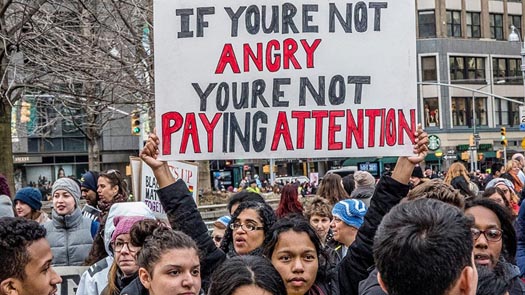
Angry women fighting sexism and misogyny in our culture

From the earliest days of Hollywood, women were stage managed and manipulated by older men in powerful positions.

And it remains clear that, although Harvey Weinstein, Les Moonves, John Lasseter, Luc Besson and James Toback, among a host of other male predatory Hollywood executives have been outed, little has changed.

In the Hollywood dream factory, trauma surfaces as light entertainment.

In 2013, introducing the list of Best Supporting Actress nominees during the Oscar ceremony, comedian Seth MacFarlane quipped: “Congratulations, you five ladies no longer have to pretend to be attracted to Harvey Weinstein.” What was chilling in that moment was that no one got the joke.
The idea that female stars and aspiring actresses are required to accept the attentions, at the very least, of older male studio executives, producers and prominent male stars, is as old as the Hollywood hills.

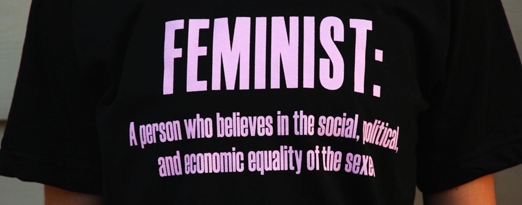
Feminist | A person who believes in the social, political, and economic equality of the sexes

Given the profile that the #MeToo movement has brought to sex discrimination, why does sexism continue to prevail in Hollywood?

According to San Diego’s State’s Centre for the Study of Women in Television and Film, women made up only 7% of directors on the top 250 films of 2019, which was actually a 2% decline from 2018.
The San Diego State study found that while women made up higher percentages of other fields in the industry – 24% of producers, or 17% of editors, for example – they only accounted for 17% of the workforce of all the jobs surveyed. And that too, was a 2% decline from the year before.

The University of Southern California’s Viterbi School of Engineering’s Signal Analysis and Interpretation Lab (SAIL) revealed how sexism is embodied by characters on the silver screen. If female characters are taken out of the plot, it often makes no difference to the story the study found.

Men’s language was linked with achievement, while their conversations contained more coarse language and was associated with sex and death. “Writers consciously or subconsciously agree to established norms about gender that are built into their word choices,” Anil Ramakrishna, one of the San Diego study’s researchers, said in a Los Angeles Times report.

Upon analysis of 1000 scripts, the study found that there were 7x more male than female writers and 12x more male directors than women.

The biggest impact in counteracting the gender imbalance was if female writers were present at script meetings. If this was the case, female characters on screen was around 50 per cent greater, the study found.

Inherent in these observations of the film industry are powerful messages about what it means to be female.

In our “post-feminist” era, where we are frequently told the problems of girls are yesterday’s news — that girls are awash in the largesse of civil rights, and it is boys who really require our attention — it is worthwhile to consider the conduct of male Hollywood writers and executives.

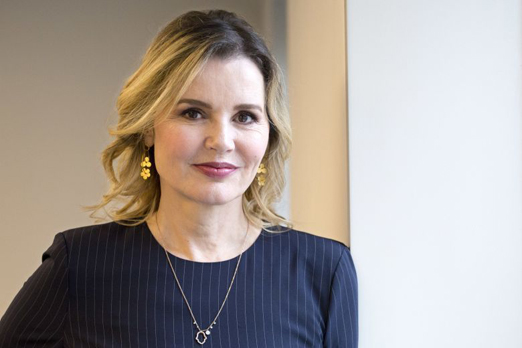
Actress Geena Davis, founder of the Geena Davis Institute on Gender in MediaActress Geena Davis, founder of the Geena Davis Institute on Gender in Media

The problem is so glaring that in 2005 actress Geena Davis, who would go on to start her own gender institute, commissioned researcher Stacy Smith, from the University of Southern California, to study the issue and help push the studios beyond the staid male-centred film industry. From 2007 through 2019, according to Smith’s ongoing research, women made up only 30.2% of speaking or named characters in the 100 top-grossing fictional films.

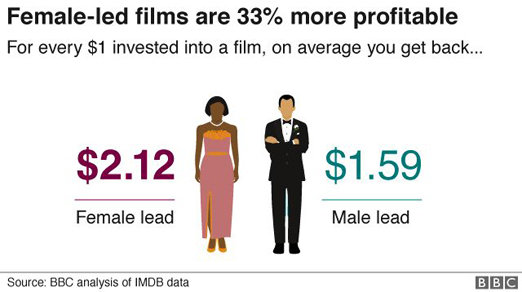
Female lead films make more money than films led by males.

The Geena Davis Institute on Gender in Media reports that films featuring women are financially profitable. “Guess what, Hollywood? Female-led films consistently make more money, year over year,” reported Madeline Di Nonno, the Institute’s chief executive, in a 2021 interview with Variety.
Hollywood actor Charlize Theron has criticized the movie industry for gender bias. Promoting her film Atomic Blonde, she told feminist Bustle magazine: “Fifteen, ten years ago, it was almost impossible to produce female-driven films, in any genre, just because nobody wanted to make it.”

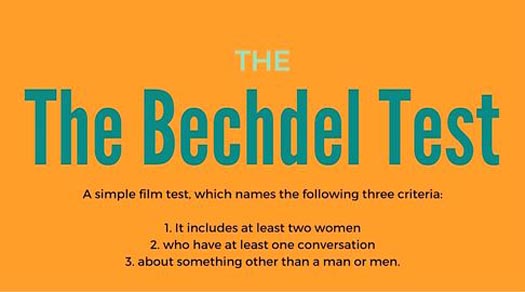
The Bechdel Test

A quiz that was designed to find out how sexist a film might be was developed by Alison Bechdel and Liz Wallace in 1985.

To pass what has become more commonly known as the Bechdel test, the film needed three positive answers to these questions: Does it have more than two named female characters? Do those two women talk with one other? Is that conversation about something other than a man?

The Hollywood Reporter applied the Bechdel test to the top-selling films in 2019, finding that only around half of the films passed the test.

The sheer scale of Hollywood sexism is daunting, the stories of what actresses have to put up with disturbing, the tales of pay inequity and pushing for more female-led stories instructive.

Actress Zoe Kazan (‘The Big Sick’) told IndieWire reporter, Kate Erbland, “There’s so much sexual harassment on set. And there’s no HR department, right? We don’t have a redress. We have our union, but no one ever resorts to that, because you don’t want to get a reputation for being difficult.”

In the lead up to this year’s Oscar ceremony, actress Emmy Rossum sounded off during a Hollywood Reporter roundtable about her experience with overt sexism in the industry.

“I’ve never been in a situation where somebody asked me to do something really obviously physical in exchange for a job, but even as recently as a year ago, my agent called me and was like, ‘I’m so embarrassed to make this call, but there’s a big movie and they’re going to offer it to you. They really love your work on Shameless. But the director wants you to come into his office in a bikini. There’s no audition. That’s all you have to do.'”

If the dynamic of older men and younger, submissive women greases the wheels of Hollywood production offices repeats itself on screen, it is not an accident, but the desires of the producers and directors who create these films played out on the biggest stage of all: Hollywood cinema, the world’s most effective propaganda machine.