
As occurs each December, Tom Charity — one of the kindest, most thoughtful and erudite men of our acquaintance, a great lover of film and who, as it happens, has long acted as the absolutely superb programmer of the Vancouver International Film Festival’s year-round Festival cinema venue, the Vancity Theatre, once again, this year, for your edification, enjoyment and just plain delight presents the Best of 2018, one time only, year-end, must-see screenings of the very best 2018 cinema had on offer.
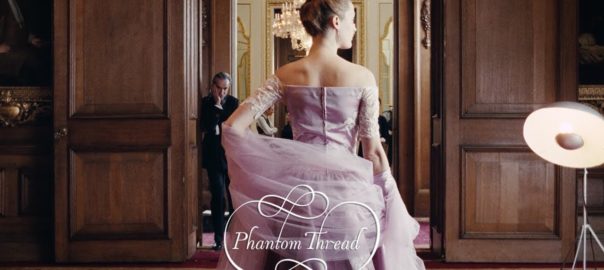
Paul Thomas Anderson’s Phantom Thread, Thursday, Dec. 27th, 8pm, Vancity Theatre.
Moira Macdonald, Seattle Times arts critic, writes, “Paul Thomas Anderson’s “Phantom Thread” casts a remarkable spell; it wraps around you, like a delicately scented cashmere shawl woven from music and color and astonishing faces.” Absurdly pleasurable to watch and to listen to, with its effortless display of poise, as Chicago Sun-Times film critic Richard Roeper writes, “Anderson shoots and paces Phantom Thread almost like a 1950s mystery, and there ARE some dark elements of intrigue in the story — but this is not a Hitchcockian tale of lust and betrayal and murder. It’s a fascinating examination of an obsessive-compulsive, maddeningly self-centered, magnificently talented man.” Captivating, unsettling, entrancing.
Debra Granik’s Leave No Trace, Friday, December 28th, 8pm, at the Vancity Theatre.
Here’s what we wrote about Debra Granik’s Leave No Trace last Friday …
Far and away the strongest and most affecting independent film of 2018, director Debra Granik’s first outing since 2010’s multiple Oscar award nominee, Winter’s Bone (in which Jennifer Lawrence made her début, gaining a Best Actress Oscar nomination), Leave No Trace tracks a father and daughter living precariously off the grid, introducing us to an incandescent 17-year-old Thomasin Harcourt McKenzie, who lives a tranquil life sheltered with her loving, PTSD suffering father, Ben Foster, in an urban Oregon woodland, in perfect harmony with one another, despite all. Uncompromising, authentic, raw, heartbreaking, brilliant, haunting, full of grace, and riveting throughout, Leave No Trace is a multiple Gotham & Indie Spirit Award nominee — including Best Actor, Supporting Actress, Director and Feature — and a must-see Best of 2018 film screening.
This past week, Thomasin Harcourt McKenzie was designated as the National Board of Review’s Breakthrough Performance award winner!
Make sure you catch The Death of Stalin on Saturday, Dec. 29th, 8pm, Vancity Theatre.
This past spring, recently-elected Vancouver City Councillor Colleen Hardwick and her husband, renowned actor Garry Chalk, caught a screening of Armando Iannucci’s The Death of Stalin at the Fifth Avenue Cinema, and came out of the theatre raving about the film to all who would listen. High praise, indeed, from persons of conscience in our community who cherish film as the critically important art form of our age.
Says New York Times film critic Manohla Dargis, “The Death of Stalin is by turns entertaining and unsettling, with laughs that morph into gasps and uneasy gasps that erupt into queasy, choking laughs,” Iannucci’s take-no-prisoners directorial style perfect for this blackest of farces, political satire of the first order, and a farcical, frightening and a timely reminder that things could always be worse — which in the time of Trump is going some.
Part of a double bill, Mandy on Saturday, December 29th, 10:10pm, Vancity Theatre.
Says CineVue’s Tom Duggins, “Mandy is not just hideous, hilarious and thrilling — although, it’s all of those and then some — it’s also a meditation on personal grief which loses no poignancy for all its blood-soaked insanity and eye-melting psychedelia.” Not enough praise?
Try this, from the Austin Chronicle’s Marc Savlov, “Mandy, though, is flat-out orders of magnitude a more emotionally adept and shockingly powerful film in virtually every department, from the dazzlingly insane cinematography and lysergically-inclined production design to what I can only believe is Nicolas Cage’s single best performance to date.”
Multiple award winner, Foxtrot, on Sunday, December 30th, 8pm, at the Vancity Theatre.
Winner of the Grand Jury Prize at the 74th annual Venice Film Festival, says the Washington Post’s Ann Hornaday, “Samuel Maoz’s award-winning Israeli film is graced by superb performances, especially from Lior Ashkenazi and Sarah Adler, this gentle, dreamlike but admirably process film offers a devastating portrait that bursts with integrity and tough honesty, even in its most lighthearted moments,” and as the Los Angeles Times’ lead film critic Kenneth Turan writes in his review of Foxtrot, “An intricate, dazzling cinematic dance, Foxtrot goes both deeper in and further out than standard-issue cinema. It’s profound and moving and wild and crazy at the same time, simultaneously telling a specific story and offering an emotional snapshot of a country whose very soul seems to be at risk.”
Paddington 2, on Monday, December 31st at noon (New Year’s Eve!), Vancity Theatre.
Probably the most enthusiastically reviewed film of 2018 — and this from a usually cynical crowd of film critics — here’s just a bit of what’s been written about Paddington 2: “An exquisite reminder of the wondrous things that can happen when a storyteller of boundless imagination avails himself of some rigorous discipline (Justin Chang, L.A. Times); and from Time Out London film critic, Helen O’Hara, “It’s a family adventure that’s the right sort of heartwarming, delivering real human emotion through the medium of a small bear.” Others have written about Paddington 2: exemplary, beguiling, enchanting, whimsical, heartfelt, humane, delightful, heartwarming, and “a sequel that surpasses the superb original.”
First Reformed, on Tuesday, January 1st at 7:45pm (New Year’s Day!), Vancity Theatre.
Perhaps the best reviewed art film of 2018, a comeback film for Paul Schrader (Taxi Driver), winner of the prestigious New York Film Critics Circle & Gotham Awards for Best Actor for Ethan Hawke — the prohibitive favourite for a Best Actor Oscar — as well as Best Screenplay for Schrader with both critics’ organizations, critic Godfrey Chesire writing, “A stunning, enrapturing film, a crowning work by one of the American cinema’s most essential artists,” while Roger Moore in Movie Nation writes, “A powerful, disturbing crisis of faith drama that takes on the raiments of a thriller, and a tour de force for the understated acting of Ethan Hawke.” Not to be missed.
Edge of the Knife (Sgaawaay K’uuna), on Tuesday, January 1st at 10pm, Vancity Theatre.
The first feature film to be spoken entirely in the Haida language, Sgaawaay K’uuna is based on a popular Haida legend, Gaagiid/Gaagiixiid (Wildman), the 19th century set film relating the tale of two families who gather together for their annual Haida Gwaii fishing camp.
A man, Adiits’ii (Tyler York), flees into a forest and transforms into a Gaagiid/Gaagiixiid (Wildman) after experiencing a tragedy. Throughout, Sgaawaay K’uuna offers mythic, human scale storytelling, where every life is sacred and no one is beyond redemption, as riveting a tale of survival and forgiveness as you’ll see this year, or any other year.
Sgaaway K’uuna, or Edge of the Knife is derived from the Haida saying: ‘The world is as sharp as the edge of a knife; as you go along, you have to be careful or you will fall off one side or the other.’
Sorry to Bother You, on Wednesday, January 2nd at 8:25pm, at the Vancity Theatre.
One the best reviewed comedies of the summer of 2018, Sorry to Bother You offers a roiling mix of wry race comedy, economy-grade dystopian speculative fiction, and inspired/demented midnight-movie Silicon Valley satire — it’s also as funny and as caustic as hell. Oh, and did we say that Boots Riley’s début feature film is also a welcome hand grenade of subversive power that is all at once incendiary, hilarious, alarming, anti-capitalist, infectious, absurdist and provocative? Gosh, I think we just did.
Support the Girls, on Thursday, January 3rd at 8:25pm, at the Vancity Theatre.
Saving the best for last, writer-director Andrew Bujalski’s heart-of-gold film offers a fresh perspective on the lives of marginalized people, in a story about sex, race, class, and age, all without ever coming off as preachy or lecturing, even given its winking/earnest double entendre of a title.
Here’s what respected film critic John Anderson had to say in the Wall Street Journal …
The unlikely, bittersweet, bristling comedy Support the Girls is easily one of the best films of the year, and the most sympathetic to women, despite having been made by a man. How can this be? Luckily, Andrew Bujalski’s remarkable movie — with its killer performance by Regina Hall (who just won the New York Film Critics Circle Award for Best Actress, and is a lock for a Best Actress Oscar nod) is not just about women. It’s about men being idiots. And no one is arguing ownership of that narrative.
Humble, restrained, breezy, heartwarming, never hectoring, delicate, cogent, tender, tough, empathetic, controlled, victorious, tumultuous, brilliant, bracing & utterly phenomenal, you need to see Support the Girls.