
Category Archives: A & E

Music & Film | Bedroom Pop, Tribeca and Skate Kitchen

Bedroom pop, a lo-fi genre of indie music popular with teens and twenties
Bedroom pop. Who’da thunk that such a thing even exists?
Bedroom pop is a sub-genre of Lo-fi (“low fidelity”), defined in 2019 as a DIY musical genre or aesthetic in which artists record at home on their own equipment, rather than in traditional recording spaces, the music characterized by contemplative lyrics, bedroom pop a contemporary indie re-invention of the once popular emo or dream pop musical genres.
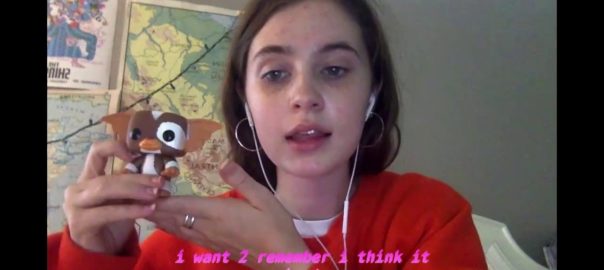
There are a great many bedroom pop artists, but the most celebrated is Claire Cottrill (born August 18, 1998), known professionally as Clairo, an American recording artist from Carlisle, Massachusetts who wrote Pretty Girl, a lo-fi-produced song that attracted over 30 million views on YouTube.

At 16 years of age, Clairo wrote and produced Pretty Girl employing studio equipment in her bedroom (the equipment sometimes referred to as a digital audio workstation), as well as Pro Tools production software, while also recording and editing the video before uploading it to YouTube.
Home studios have been popular for decades, but have become ever more refined as computer technology has become increasingly sophisticated, enabling ever higher quality music production. One of VanRamblings favourite artists, Imogen Heap (who we interviewed and wrote about in 1997, at the outset of her career) records all of her music in her kitchen, where she’s set up a home studio that revolves around the use of Pro Tools.

As it happens, VanRamblings discovered bedroom pop during our recent bout of illness, when all we could manage to do most days was plunk ourselves down in front of Netflix — where we were very pleased to see that Crystal Moselle’s acclaimed Sundance and Tribeca award-winning film, Skate Kitchen, simply appeared out of the blue (and unheralded, but not by us) one very fine day, as one of the varied viewing options.

Vibrant, alive, poetic, superby shot and and richly informed, Ms. Moselle’s follow-up to her award-winning, one of a kind documentary, The Wolfpack, her fiction début emerges as the most accomplished film about skater culture since Catherine Hardwicke’s 2005 American biographical drama, The Lords of Dogtown (which is also available on Netflix).
The story goes that Moselle spotted two of the girls on the subway, introduced herself as a filmmaker, and asked if there were more girls like them. Indeed there were, all forming a feminist, sex-positive, shred-happy collective called the Skate Kitchen. Some time later, Moselle’s film arrived in Park City, with all the kids playing a version of themselves.
And who do you think the featured music artist on the soundtrack might be? Yep, you got it — none other than Clairo, who wrote and produced Heaven for the Skate Kitchen soundtrack.

So, while VanRamblings reveled in our discovery of Skate Kitchen on Netflix, we were also introduced to Clairo, and the contemporary musical genre known as “bedroom pop.” And now, you are familiar with Skate Kitchen (a must, must watch!), the work of Crystal Moselle, the musical genre of bedroom pop, and its most acclaimed progenitor, Clairo.
You know what’s exciting about life? That you get to discover something new, something that just yesterday you knew nothing about, every day.
Christmas to New Year’s The Busiest Film Week of the Year

Holiday Season Movies to See Over the Christmas Break

The week of Christmas to New Year’s is the biggest box office film week of the year. More people go to the movies on Christmas Day through New Year’s Eve than attend films in the entire months of April and September.
In that one week last year, box office topped $500 million dollars, every seat was sold out, the line-ups were long, and chances are that if you didn’t purchase your ticket online in advance, you weren’t going to find a seat in the theatre for the movie you wanted to see. Count on the same in 2018.
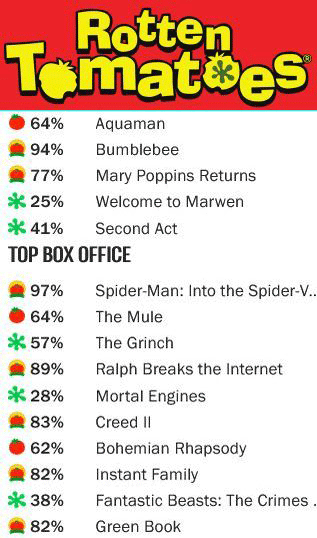
The question remains, what to go and see at the theatre? Many people rely on Rotten Tomatoes, the film critic review aggregation site, although many others prefer MetaCritic, given that the site features only the most erudite, professional and trusted film critics on their better curated aggregation site.

Rotten Tomatoes: Top Movies on the Weekend Before Christmas 2018

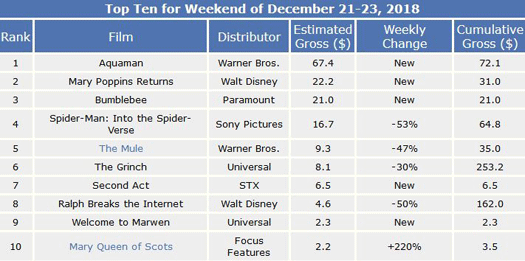
Box office on the weekend before Christmas looked like this …

Box Office on the weekend before Christmas 2018

Okay, okay, enough of this folderol. Time to get on with why you’re here perusing VanRamblings today. Let’s start with …

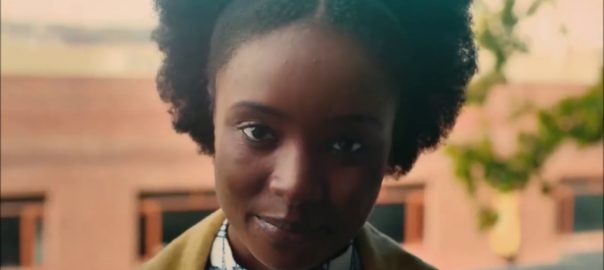
Currently sitting at 94% on Rotten Tomatoes, the latest film from 2018 Best Picture Oscar award winner (Moonlight), Barry Jenkins, If Beale Street Could Talk, here’s what The Telegraph’s lead film critic Tim Robey has to say: “If proof were needed that Barry Jenkins’s directing achievement was far from a one-off, it pulses and dances through every sequence of his follow-up, If Beale Street Could Talk, in all its gorgeous romantic melancholy and sublimated outrage.” 5-stars Opens Christmas Day.

Although reviews for the new film from Adam McKay (The Big Short) are decidedly mixed, with a 68% rating on Rotten Tomatoes, USA Today’s Brian Truitt writes about Vice, “Exquisitely crafted … It’s a strange little amalgamation that totally works: a vicious Shakespearean satire about power-hungry mind-sets, stealth corruption, American ambition and the current state of divided affairs in America, but also a quasi-fictional go-for-broke biopic about a political leader we really don’t know at all.”
Lots of Oscar buzz, though, most particularly for Christian Bale and Amy Adams, and even if it’s revisionist history — painting a far too rosy picture of the Bush administration — the film looks like fun. In the era of Trump, we need all the fun we can get. In this case, Vice may be just the ticket.

Here’s what the critics have to say about Bumblebee

Bumblebee is, again and easily, the best Transformers movie released to date. Heck, it’s probably the only genuinely good Transformers movie, with nary a caveat to be found. But it’s also a lively and earnest 1980s nostalgia trip, made with affection for the era and its characters and its soundtracks and its storytelling styles and, yes, even its toys.

What Bumblebee does best is remember that this is a franchise for the young, and embrace that fact without any shame while also still delivering on the action. There’s no self-importance, no grafting of ultra-patriotism and too-dense mythology onto what should be a simple narrative.

There’s a lot to like here, particularly Hailee Steinfeld’s performance.

Box office the weekend before Christmas doesn’t presage how a movie will do Christmas week: here’s betting that Bumblebee triumphs. Doesn’t really matter, though: Bumblebee’s foreign box office will easy double or triple the domestic, North American box office. Bumblebee seems recommendable.

With Shoplifters, Japanese director Hirokazu Kore-eda’s enchanting, subversive masterpiece takes on family values & bourgeois pieties through a Japanese crime family that is not what it seems, proving that Tolstoy got it wrong and Shoplifters gets it right. All happy families are not the same. Winner of the Palme d’or at Cannes this year, probable Best Foreign Language Oscar winner, currently playing at Cineplex International Village.
Note should be made that with Shoplifters, Kore-eda works in a beautiful register that feels both detailed and genuine at the same time, allowing us to get to know these characters so deeply that it is heart-wrenching, the film wise and insightful always, delicate, modest, skillful, compassionate, piercingly intelligent, poignant, memorable, and unexpectedly powerful.

Best of 2018 at VIFF's Vancity Theatre

Now, I’ve already written about the Best of 2018 at the Vancouver International Film Festival’s Vancity Theatre, the comfiest, friendliest and most welcoming cinema in Vancouver, this superlative year-end series programmed by the peerless Tom Charity. The 10 films in the series start their run on Wednesday, December 27th, and concludes eight glorious days later on Thursday, January 3rd. Not to be missed. See ya at the Vancity.
For more info on VIFF’s Best of 2018 series just click on the links.

And, oh yeah — don’t forget: Alfonso Cuarón’s probable Best Picture Oscar winner, Roma, continues to play to sold-out houses each day, exclusively at the Vancity Theatre. Gorgeous and moving, and also not to be missed.

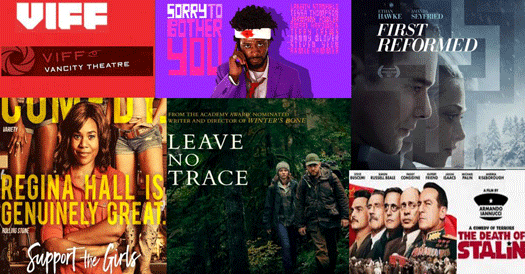
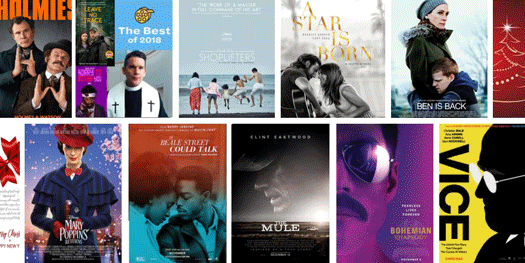
And, finally, there’s this, an amalgam of films screening around Vancouver, or set to come to the Vancity, or opening near you, during the course of the next month, including a few Best Foreign Language Oscar nominees.

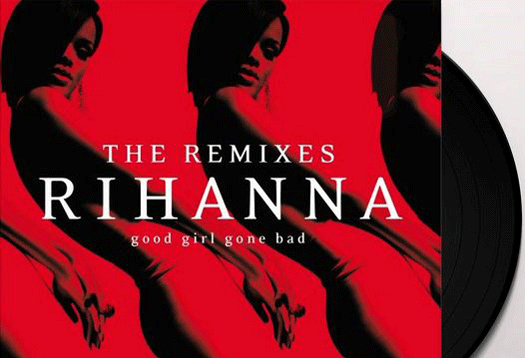
The Music of One’s Life | Rhianna, and the ReMixes

Rihanna remixes

My musical tastes run the gamut: progressive and old-timey country, folk, Americana, lounge, progressive dance, klezmer, world beat, Celtic folk, Japanese pop, trip-hop, orchestral, urban pop, hip hop soul, rhythm and blues, acoustic, dirty bass south, avant-garde, europop, gospel, house music, dream pop, trance, ambient and downtempo, acid jazz, rock ballads, post-Britpop — and with all that, I’m only scratching the surface of the types, styles and genres of music I love which constitute the soundtrack of my life, the various genres of music which you’ll come to hear through this screen in the days, weeks, months and years to come.
Where I am a listener and an appreciator of music, with some background in piano and guitar — long forgotten, alas — my son Jude, a recording engineer and D.J. creates his own complex, layered, multi-dimensional music, electronica for wont of a better word. Jude records under the name Dj Nameless, as has been the case for well more than a decade now.

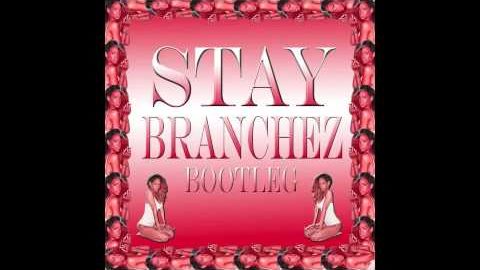
I love well-produced, textured music, and remixes, of which you’ll be hearing a great deal more in the time to come. Today, a remix by New York-based D.J. Branchez of Rihanna’s 2012 chart topper, Stay. When this song pops up on my iTunes playlist, through my bluetooth headphones, when I’m heading downtown to a movie, the bus crowded, rain pelting down on the bus, the wetness of the day permeating not just the clothing but the very souls of the people around me, the Branchez bootleg remix of Stay simply raises my mood — see if it does the same thing for you.

The Music of One’s Life | Tom Waits | Closing Time +

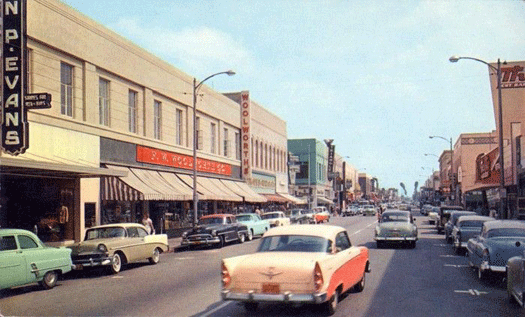
Pomona, California, 1950s, birthplace of singer-songwriter Tom WaitsPomona, California, Los Angeles county, 1950s, birthplace of songwriter Tom Waits

Thomas Alan Waits was born on the 7th of December in 1949, in Pomona, California, a little town located between the Inland Empire and the San Gabriel Valley, situated within Los Angeles County. His father, Jesse Frank Waits — about whom Waits would later say … “he was a tough one, always an outsider” — taught Spanish at a local school and was an alcoholic, while his mother Alma was a housewife and regular church-goer.
Waits was the second of three siblings, having both an older and younger sister, raised (as he’s often said) in a middle-class household, his “a pretty normal childhood”. He attended Jordan Elementary and later on Hilltop High School, where he was bullied. It was at Hilltop, though, where he learned to play the bugle and the guitar, while his father had earlier taught him to play the ukulele. Summers, more often than not, he visited maternal relatives in Gridley or Marysville, both small towns about 50 miles north of Sacramento, in northern California. Waits recalls that it was an uncle’s raspy, gravelly voice that inspired the manner in which he later sang.
In 1959, Waits’ parents separated and his father moved away from the family home; it was a traumatic experience for the 10-year-old boy. Alma took her children and relocated to Chula Vista, a middle-class suburb of San Diego. In Chula Vista, he fronted a rhythm and blues school band, The Systems, where he developed a love of soul singers like Ray Charles, James Brown, and Wilson Pickett, as well as country music and Roy Orbison. Later on, Bob Dylan became a catalytic influence, with Waits placing transcriptions of Dylan’s lyrics on his bedroom walls.

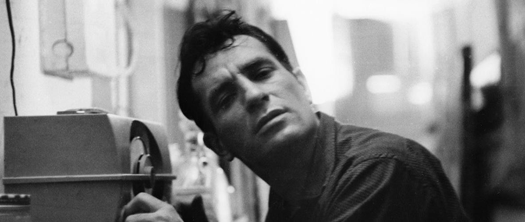
Novelist Jack Kerouac, listening to the beat of a new generationNovelist Jack Kerouac listening to the beat of a new generation, where as he wrote, “The only people for me are the mad ones, the ones who are mad to live, mad to talk, mad to be saved, desirous of everything at the same time, the ones who never yawn or say a commonplace thing, but burn, burn, burn, like fabulous yellow roman candles exploding like spiders across the stars.” Excerpted from Kerouac’s 1956 novel, On The Road.

In high school, Waits was a self-described “amateur juvenile delinquent”, interested in “malicious mischief” and breaking the law, a “rebel against the rebels”, as he eschewed the hippie subculture then growing in popularity, inspired instead by the 1950s Beat generation, with a great love for the work of Beat writers like Jack Kerouac, Allen Ginsberg, and William S. Burroughs. In 1968, at age 18, he dropped out of high school.

The Howl, Allen Ginsburg, September 1956

I saw the best minds of my generation destroyed by madness, starving hysterical naked, dragging themselves through the negro streets at dawn looking for an angry fix, angelheaded hipsters burning for the ancient heavenly connection to the starry dynamo in the machinery of night, who poverty and tatters and hollow-eyed and high sat up smoking in the supernatural darkness of cold-water flats floating across the tops of cities contemplating jazz, who bared their brains to Heaven under the El and saw Mohammedan angels staggering on tenement roofs illuminated, who passed through universities with radiant cool eyes hallucinating …

Waits spent much of the next three years traveling, picking up odd jobs here and there, taking college classes in photography, while all the while pursuing his musical interests, including learning the piano, all of which led to gigs along California’s coast, opening for acts like Tim Buckley, and Sonny Terry and Brownie McGhee.

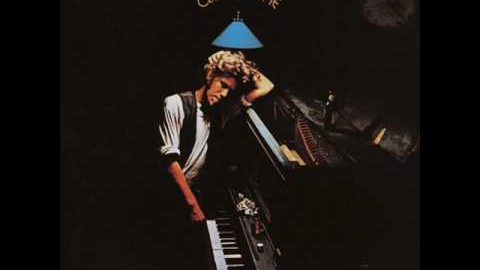
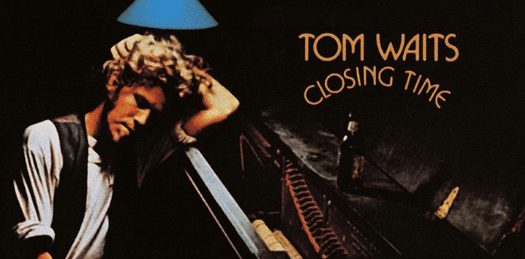
Tom Waits, debut album, Closing Time, March 1973

Early in 1972, Tom Waits landed a gig at the Troubadour in West Hollywood, where he came to the attention of Herb Cohen, a music impresario, record company executive, music publisher, and personal manager for Linda Ronstadt, Frank Zappa, Buckley, and Odetta, among other artists. Cohen signed Waits to a publishing contract with Troubador Records — it was at Troubador that Waits came to the attention of David Geffen, who gave Waits a recording contract with his Asylum Records, the recording sessions taking place in Hollywood’s Sunset Sound studios, the resulting album titled Closing Time, released in March 1973. The rest, as they say, is history.

In a down period of my life, living in a tiny apartment in Coquitlam, teaching school, my Master’s programme falling apart, and the state of my marriage — if such a thing even existed anymore — undecided at best, I took solace with music from Waits’ 1980 album Blue Valentine, most particularly his version of Leonard Bernstein’s Somewhere, from West Side Story (which, for me, is the definitive version of the song). As you can hear, by this point in his career, Tom Waits had developed his signature raspy and heartrending voice. Both songs remain among my favourites to this day.