All posts by Raymond Tomlin

About Raymond Tomlin

Raymond Tomlin is a veteran journalist and educator who has written frequently on the political realm — municipal, provincial and federal — as well as on cinema, mainstream popular culture, the arts, and technology.

Vancouver Board of Parks and Recreation: COPE Has The Right Plan


VANCOUVER-PARKS-BOARD-COPE


VANCOUVER-MUNICIPAL-ELECTION


l-r: Spencer Herbert, Anita Romaniuk, Omar Kassis, Jenn McGinn, Mel Lehan, Loretta Woodcock

Last week, VanRamblings published a story endorsing COPE — Vancouver’s Coalition of Progressive Electors civic party — as the only municipal party that champions a sustainable programme of development that balances economic and environmental interests, towards the creation of a more livable city for all of us. Have already wholeheartedly endorsed the COPE slate of candidates for City Council and School Board, VanRamblings turns its attention today to the robust COPE Park Board slate.
Over the course of the past three years, a COPE Park Board, while enhancing public participation and access to the Board, has …

  • Championed the inclusion of 26 acres of park, and a 30,000 sq. ft. community centre at the future southeast False Creek development
  • Expanded wheelchair access in our parks and introduced universal design principles to accommodate all members of the public, regardless of physical and mental ability
  • Established skateboard parks beneath the east end of the Georgia Viaduct, and in the Strathcona and Quilchena neighbourhoods
  • Expanded the Champlain Community Centre, including new child care facilities; rebuilt and expanded the Killarney Pool; undertook an extensive renovation of Renfrew Pool; completed the Millennium Lawn Bowling and Gymnastics facility at Riley Park; established a new artificial turf playing field in Kerrisdale embraced by the community; and established new, or renovated, parks including Emery Barnes, Sahali, Tea Swamp, Strathcona, Heather, George Wainborne, David Lam Phase Two, and Kingcrest
  • Extended off leash hours for dog parks, while promoting public education for dog owners
  • Promoted and facilitated community gardens throughout the city, and
  • Improved environmental practices, including the diversion of rainwater into daylighted streams, as well as the re-use of rainwater for irrigation; expanded the use of green building technology and energy conservation; expanded the recycling programme and the re-use of materials; and continued our commitment to the Cool Vancouver Climate Change plan, with the goal of reducing greenhouse gases

In only a few days, you will be asked to cast your ballot for a new Park Board. Sitting COPE Park Board commissioners Anita Romaniuk and Loretta Woodcock, and new candidates Mel Lehan, Spencer Herbert, Omar Kassis, and Jenn McGinn are deserving of your vote. If a majority COPE Park Board is elected to a second term, a COPE Park Commissioners team would …

  • Continue the renewal and expansion of community centres, ice rinks, swimming pools, and fitness centres
  • Move Park Board meetings into community centres, and create an open dailogue with the community
  • Approve a plebiscite for the 2008 civic election on whether or not to phase out the containment of whales and dolphins in Stanley Park
  • Continue the development of guidelines for waterfront and shoreline activities through the new Waterfront Planning Study
  • Engage in a consultative process with young people to enhance youth programming in parks and recreation centres
  • Adopt the LEED gold standard for new facilities, thus reducing future operating costs as well as reducing environmental impact
  • Keep annual operating expenses and annual inflationary fee increases for facilities and programmes within the target inflationary increases set by the City, while rolling back the NPA-approved 7% increase in seniors fees for golfing, swimming, and fitness centres passed for the 2003 budget

These are good people. Hard-working people. Caring people. On November 19th, when you cast your ballot for a reinvigorated Vancouver Park Board, VanRamblings urges you to support the COPE team of Park Board candidates — Spencer Herbert, Omar Kassis, Mel Lehan, Jenn McGinn, Anita Romaniuk, and Loretta Woodcock — all of whom will work towards the creation of a more livable city for each and every one of us.

Wal-Mart The Movie: The High Cost of Low Price


WAL-MART-THE-MOVIE


VANCOUVER-MUNICIPAL-ELECTION


Click on picture to enlage poster

Sunday, at 7 p.m. at the VanCity Theatre, director Robert Greewald’s much-praised and controversial new film Wal-Mart - The High Cost of Low Price will première in Vancouver as a benefit screening for Vancouver’s COPE municipal party.
You know Wal-Mart’s inglorious history. Child exploitation. Earlier this year, Wal-Mart Stores agreed to pay $135,540 to settle federal charges in the U.S. that it violated child labour laws in Connecticut, Arkansas and New Hampshire.
Wal-Mart’s culture of crime and greed. In March of this year, only eight short months ago, Wal-Mart paid $11 million to settle charges that it employed hundreds of illegal immigrants to clean its stores across the United States.
Workers have been illegally fired for trying to form a union, and Wal-Mart spends millions to thwart workers basic rights, giving its union-breaking staff priority on resources (like corporate jets) over even higher-placed managers. In 2000, meat cutters at a Wal-Mart in Texas voted for the union — and Wal-Mart promptly violated the law by shutting down the meat-cutting department in the store and, for good measure, closed every other meat-cutting department in 179 other stores across the U.S. and Canada, just to make sure they had stamped out any smell of unionism.
And let’s not forget Wal-Mart’s shuttering of their Jonquierre, Québéc store, in May of this year, after its employees received union certification. A former employee at that store has filed a class-action suit in the Québéc Supreme Court claiming that Wal-Mart, in closing the store, “violated the rights of its workers” by breaching the Canadian Charter of Rights and Freedoms, which guarantees freedom of association to all citizens.
Then there’s Wal-Mart’s wage policies, which deny its workers the basic right to a living wage, not to mention the off-the-clock work they force on their employees, and unequal pay and treatment to which they subject their employees. Wal-Mart’s discriminatory policies in regards of their female staff have resulted in the largest workplace-bias lawsuit in U.S. history.
You know the story: poverty-level wages, with a staff turnover rate of 50% a year; destruction of local businesses due to predatory pricing (an Iowa State University study found that in the first decade after Wal-Mart arrived, the state lost 111 men’s and boys’ apparel stores, 116 drug stores, 153 shoe stores, 158 women’s apparel stores, 161 variety stores, 293 building supply stores, 298 hardware stores, and 555 grocery stores); numerous labour law violations, ranging from illegal spying on employees and falsification of time cards to avoid paying overtime to fraudulent record keeping and illegal firings for union organizing; the record-holder for the most suits filed against a U.S. company by the Equal Employment Opportunity Commission (Wal-Mart had to pay a $750,000 fine for blatant discrimination in Arizona against the disabled. The judge even ordered Wal-Mart to air commercials confessing their guilt); and more, much more.
But you don’t know the whole story. You won’t gain a true insight into Wal-Mart corporate practices until and unless you attend this Sunday evening’s screening of Wal-Mart — The High Cost of Low Price. Until you hear for yourself the shattering experiences of the current and former Wal-Mart employees Greenwald interviewed, this story will be little more than words on a screen. Sunday evening. See you at the VanCity theatre.

Remembrance Day 2005: A Pittance of Time


REMEMBRANCE-DAY-2005


On November 11, 1999 Terry Kelly was in a Shoppers Drug Mart store in Dartmouth, Nova Scotia. At 10:55 a.m. an announcement came over the store’s PA system asking customers who might still be on the premises at 11:00 a.m. to give two minutes of silence in respect to the veterans who had sacrificed so much for all of us.
Terry found himself moved by the store’s role in adopting the Legion’s “two minutes of silence” initiative, and felt that the retail outlet’s contribution in educating the public to the importance of remembrance was both appropriate and laudable.
When 11 o’clock arrived, an announcement was again made asking for “two minutes of silence” to commence. All customers, with the exception of a man who was accompanied by his young daughter, showed their respect.
Terry’s chagrin at the conduct of the father who was demanding service from the store’s clerks rather than show appropriate respect, in the process setting a poor example for his daughter, was later channeled into a beautiful piece of music, titled A Pittance of Time. VanRamblings today presents Mr. Kelly’s award-winning, moving video of A Pittance of Time.

Paris is Burning: Racism, Poverty and Police Brutality


PARIS-IS-BURNING

VanRamblings first became aware of the divide between Muslim Arab immigrants and the majority French population seven years ago during a screening of Jeanne and the Perfect Guy when, in the film’s opening scene, the Muslim, Arab and black janitorial staff at a chic Paris travel agency break out into song decrying the exploitative treatment each experiences at the hands of the French, and the pervasive sense of exclusion each feels, their diaspora to France hardly welcome despite the necessity of their labours.
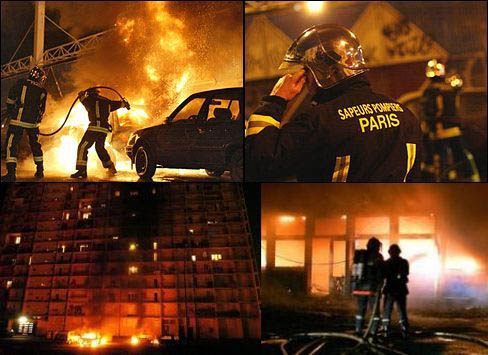
Now, in fall 2005, after almost two weeks of violent clashes between youth and police, as the world looks on in stunned disbelief at the destruction of the social fabric in France, many of us our looking for answers as to why “a tsunami of inchoate youth rebellion” is engulfing France.
As Doug Ireland writes in his piece, Why Is France Burning? The Rebellion of A Lost Generation, “To understand the origins of this profound crisis for France, it is important to step back and remember that the ghettos where festering resentment has now burst into flames were created as a matter of industrial policy by the French state.”

It is the result of thirty years of government neglect: of the failure of the French political classes — of both right and left — to make any serious effort to integrate its Muslim and black populations into the larger French economy and culture; and of the deep-seated, searing, soul-destroying racism that the unemployed and profoundly alienated young of the ghettos face every day of their lives, both from the police, and when trying to find a job or decent housing.

In the course of his essay, Ireland suggests that the events of the past two weeks can be attributed to institutionalized racism and a long, inglorious exploitation of 10% of the population who have consistently been locked out of political decision-making, and denied access to basic education, housing and social services. The history of such treatment of the Muslim, Arab and black population dates back almost a half century.
During the post-World War II boom years of reconstruction and economic expansion, the government recruited labourers and factory and menial workers from France’s foreign colonies. These immigrant workers, primarily from North Africa, were desperately needed to allow the French economy to expand due to the shortage of manpower caused by two World Wars, killing many French men, and slashing native French birth-rates. Moreover, these immigrant workers were favoured by industrial employers as passive, unlikely to strike and cheaper to hire. Literacy, too, was a disqualification, because an Arab worker who could read could educate himself about politics and become more susceptible to organization into a union.
Upon arrival and since, these Arab workers were and are warehoused in huge, high-rise low-income housing ghettos — known as cités (Americans call them ‘the projects’) — specially built and deliberately placed out of sight in the suburbs so that their darker-skinned inhabitants wouldn’t “pollute” the larger metropolitan centres. Now 30, 40, and 50 years old, these high-rise human warehouses in the isolated suburbs are dilapidated, sinister places, housing the hopeless and the alienated, an undereducated, oppressed and rage-filled population of the dispossessed.

Continue reading Paris is Burning: Racism, Poverty and Police Brutality