Monthly Archives: May 2004

A Kerry Landslide?
Why the next U.S. election won’t be close


AMERICAN-PRESIDENTS


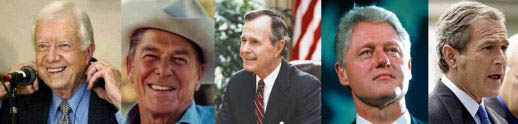
Conventional wisdom has it that the 2004 U.S. Presidential election will be extremely tight. But history shows that an election with an incumbent president tends to function as a referendum, which could mean a big win — or a big loss — for Democratic hopeful, Massachusett’s Senator John Kerry.
In a column written for The Washington Monthly, editor-in-chief of the National Journal’s Hotline, Chuck Todd, suggests the race for President may not be as close as most pundits believe. In fact, writes Todd …

“2004 could be a decisive victory for Kerry. The reason to think so is historical. Elections that feature a sitting president tend to be referendums on the incumbent — and in recent elections, the incumbent has either won or lost by large electoral margins. If you look at key indicators beyond the neck-and-neck support for the two candidates in the polls — such as high turnout in the early Democratic primaries and the likelihood of a high turnout in November — it seems improbable that Bush will win big. More likely, it’s going to be Kerry in a rout.”

In a prescient BBC article, published in December 2002, correspondent Paul Reynolds compares the presidencies of Jimmy Carter and George W. Bush, offering an analysis of what brought Carter down.
Although Reynolds suggests that George W. Bush intended not to be burdened by the same problems — the economy and foreign policy — that defeated Carter, in fact, given the events of the past few months, if you contrast the problems that plagued the Carter administration with those of the Bush White House, the current president’s tenure would seem uncertain, indeed, based on recent U.S. political history.
Clues For The Clueless: Explaining The World Around Us


SCIENCE-EXPLAINED


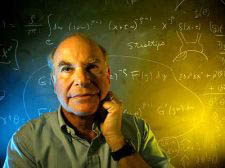
Caltech string theory pioneer John
Schwarz explains science to the public

These days, laptop computers employ technology scarcely dreamed of during the Apollo moon missions. Physicians prescribe gene-triggering drugs that were fantasy elixirs a decade ago. And microchips have become so small that they’re measured in billionths of a metre. But more than 80% of adults still are not knowledgeable enough to digest a science story in a major newspaper. So how do scientists learn to explain without dumbing down?
As science becomes more complex, more prominent in everyday life and more dependent on the support of the public for research — through the government grants funded by the taxes we pay — universities across the globe are reaching out to the ‘clueless’ — that means, you and me.
The goal is to nurture popular support for scientific endeavours by making them easier to understand. And, in a world where the hope for cures to most diseases rests with the skilled endeavours of biotechnologists, and where the very definition of democracy is being redefined by the advent and continued maturation of the Internet, the more we know about science, the implications of the research that is being undertaken, and the moral and ethical questions involved in that research, the better off we’ll all be.
Writing for The Los Angeles Times, science reporter Paul Pringle — in a story titled Dense Matter Indeed — records the thoughts of people like you and me, who suggest to scientists that by employing more descriptive language, developing eloquent process imagery, as well as public-friendly metaphors that science might be brought down to Earth.
At which point, each and every one of us will benefit, as we feel better informed and more empowered in yet another aspect of our lives. More acute knowledge on a subject is almost always a good thing.

Tarantino, Almodóvar Get Cameras Rolling at Cannes


QUENTIN-TARANTINO


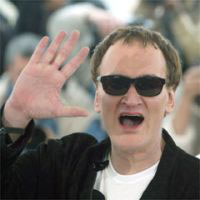
Quentin Tarantino catching a fly

The 57th annual Cannes International Film Festival is off to a rousing start, with the head of the jury slugging a security guard on the way into a screening of Man Bites Dog by Belgian actor, writer and fellow jury member Benoît Poelvoorde.
So much for Quentin Tarantino’s first day on the promenade.
For the next 12 days, the French Riviera city will host a dizzying run of screenings, publicity spectacle, dealmaking and exclusive parties attended by more than 15,000 movie paparazzi and movie writing hangers on. The galaxy of A-list stars expected to attend this year include: Brad Pitt, Charlize Theron, Maggie Cheung, Cameron Diaz, Gong Li, Penélope Cruz, Uma Thurman, Tom Hanks, Sharon Stone and Sean Penn. Y-y-a-a-w-w-n-n.
Okay, okay. At least in part, the Cannes Film Festival is about movies. In that regard, Spanish director Pedro Almodóvar kicked off the festival with Bad Education, a dark tale of priests’ sexual abuse of boys, homosexual love and lies.
Otherwise, want to know what’s going on at Cannes? James Mottram, of Britain’s Channel 4, offers a straightforward account of the “well-balanced affair,” while Roger Ebert reflects on the meaning behind Cannes, in the process offering hints as to the films which may emerge as contenders for the coveted Palme d’Or, the top prize at the festival.

Kerry and McCain: The Winning Ticket Against Bush/Cheney?


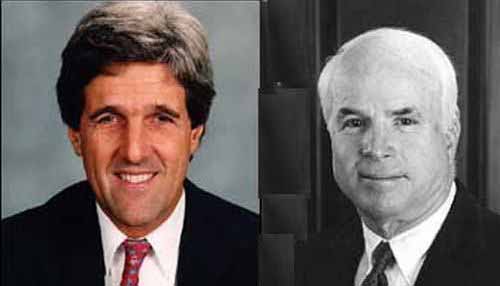
Presidential hopeful John Kerry, and Senator John McCain for the Democratic ticket this November?

Word out of Washington, D.C. this morning has Democratic party Presidential hopeful considering five candidates for the Vice-President’s slot on the ticket: John Edwards, retired General Wesley Clark, Richard Gephardt of St. Louis, Senator Bob Graham from Florida, and Iowa Governor Tom Vilsack.
All and all, a pretty lacklustre group of potential running mates for a Kerry campaign already dogged by allegations of unutterable dullness.
Although there’s been some blue sky speculation / hopeful thinking about a John Kerry / John McCain Democratic ticket come November, The New Republic’s senior editor, Andrew Sullivan, goes a bit further than previous commentators.

In office, McCain could be given real authority as a war-manager, providing a counterweight to Kerry’s penchant for U.N.-style non-solutions … Domestically, a Kerry-McCain ticket would also go a long way toward healing the Vietnam wound, now rubbed raw again by recent events in Iraq … The next president, whomever he is, may well have to encounter seismic shocks from new terrorist atrocities in America and the world. Under those circumstances, America cannot afford more polarization, partisan division, and acrimony. In parliamentary democracies, such crises sometimes provoke the formation of a ‘national government’ in which both major parties serve together.

A United States government of national reconciliation? With each passing day, and as the position of the United States only continues to worsen — with the continued publishing and broadcast of horrendous pictures and video from Iraq, with the Bush administration’s failed policies on the environment, with the potential for a privatized education system, and a thousand other issues of concern to working Americans — VanRamblings joins the call for the Kerry campaign to implore John McCain to run on the Democratic ticket, to heal the wounds of division that have torn Americans apart, so that order might once again be re-established in the U.S., and the lives of each and every one of us will not be imperiled to the degree that has become the case under Bush.