
Monthly Archives: April 2004

The Tech Week in Review, Part 2


LONGHORN


For those of you who consider yourself to be early adopters, Microsoft has just released a public beta version of Windows Service Pack 2.
Fred Langa warns “beta means an ‘unfinished prototype’. All betas carry risks, and can be hard to undo if or when they cause problems. But operating system betas are even riskier because they change the very foundation of your system software. Unless you have a safe test environment such as a second PC; and/or unless you have a complete image-based backup of your entire system and are prepared to use it; don’t fool around with OS betas.”
Meanwhile, Fred offers 10 Ways to Make Windows XP Run Better and 10 More Ways to Make Windows XP Run Better.
C|NET responds to a member question …

QUESTIONMARK

Is there an easy way for Windows to always maximize a window size when I launch an application? Windows has forgotten my settings.
—Submitted by Karen C. of Birmingham, AL

ANSWERGIF

The simple way is to:
1. Open an application (such as Excel).
2. Maximize the window using the Maximize button in the top-right corner.
3. Hold either Shift or Ctrl on your keyboard and close the application window by pressing X or File > Close/Exit.
ZDNet’s David Berlind writes, “Voice over Internet Protocol (VoIP) promises to help us cut telephone costs and pave the way for converged data and voice networks that can deliver advanced communications applications to users, anytime, anywhere. However, the promises of VoIP may not be enough to meet the business requirements of enterprises. In our Webcast, we evaluate the benefits of VoIP versus the risks, looking at quality of service, security, infrastructure requirements and other key criteria”.
Meanwhile, ZDNet’s Mike Ricciuti writes that Microsoft’s long-promised beta version release of Longhorn — the next iteration of Microsoft’s OS — will most likely have to wait until next year as Microsoft set out to bolster Windows XP security, in light of the plethora of Trojan, worm, malware, spyware and other attack of its current OS.
Plus, happy days are here again: there’s a new version of WinAmp available.
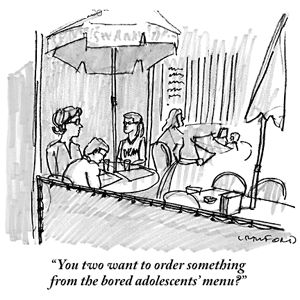
Boredom As A Lost Art Form


BORED


Danish philosopher Søren Kierkegaard called it “the root of all evil.” The English Romantic poet William Wordsworth described it as a “savage torpor.” To Seán Desmond Healy, the author of one of several book-length studies on the subject, boredom is the “silent scourge” of modern culture. Known as “acedia” to centuries of Christians, it was nothing less than a sin.


As an elementary and secondary public school teacher, the most common lament I heard each day was “I’m bored.”
In an age of quick-cut MTV videos, overamped special-effects action flicks, hip-hop and urban radio blaring into our ears from every direction, the frantic chirping of our cell-phones and the insistent beeps of instant messaging, not to mention all of those readily available pharmaceuticals which have been designed to enhance the ‘dreariness’ of our day-to-day existence, it would appear that boredom is a facet of our prosaic lives that is to be avoided at all costs.
San Francisco Chronicle Arts and Culture Critic Steven Winn isn’t quite so sure that boredom is all that unhealthy a feature of our lives. Quoting choreographer Brenda Way who, when she finds herself in a sluggish lane of traffic, often stays put, “the unfocused, unintentional time of feeling bored … opens the unconscious scanning that’s the very stuff of problem solving and creativity.”
Others have something to say on the subject, as well.

“Boredom is paradise,” exults the poet Billy Collins, by e-mail from New York. It’s “the blessed absence of what the world offers as ‘interesting,’ i.e., the lures of fashion, media and other people, which, you may recall, Sartre considered Hell.”


We’ll leave the final words on the subject of boredom to Winn: “A culture frantic to entertain, stimulate, divert and inform us is in no danger of drowning out boredom. If anything, it may make that placid sense of turning off and turning away, buoyantly detached and rising to the opportunity, more valuable than ever.”

A Political Blogger, Untamed, Rattles Cages in D.C.


WONKETTE


THE WONKETTE
: Ana Marie Cox is the saucy writer behind a weblog about politics that is attracting a following in election-year Washington, D.C.


The Washington Post’s Anne Schroeder, in an interview with The Christian Science Monitor’s Danna Harman, references Washington, D.C.-based blog, wonkette.com, and says of editor Ana Marie Cox: “She’s fun and fresh and right on the money — and is writing what others think but can’t always write … She can curse, for example.”
Harman, herself, writes that wonkette.com “is also another example of the boundary-busting powers of the Internet, where writers like to be less deferential to authority” — an entirely salutary trait in a writer, always.
Mischief-making, with a sense of humour and a fresh, informed and irreverant take on the events of the day, now that sounds like a formula for blogging success. And, of course, it doesn’t hurt that Ms. Cox’s politics are left — “big fat commie pinko,” as she puts it.

Solitude: A Writer’s Best Friend

… it becomes clearer and clearer that fundamentally solitude is nothing that one can choose or refrain from. We are solitary. We can delude ourselves about this and act as if it were not true. That is all. But how much better it is to recognize that we are alone; yes, even to begin from this realization. — poet Rainer Maria Rilke


SITTINGALONE


Writerly solitude, on a park bench alone

For many, the most salient aspect of writing is the time that is spent alone in front of the computer (or, in some cases, typewriter, or writing pad). In a world that demands some form of sociability from us, how wonderful the notion can be of simply spending some time alone, seeking only one’s own counsel.
There is a certain amicable integrity to solitude, as well.
If you’ve been a reader of VanRamblings for awhile, the thought must have occurred to you as to why the sobriquet VanRamblings was chosen as the identifying URL. Well, if you haven’t figured it out already, this writer tends to ramble; the rambling on VanRamblings tends to be reflected in run-on sentences, paragraphs, and brief essays — thus (Van)rambling(s).
By extension, if one rambles when writing composition, there’s not much of a logical leap that need be made to imagine the nature of the personal, communicative interaction one might enjoy with such a person. Which is to say, I ramble in public, as well: on and on, words and sentences, paragraphs and whole essays of thoughts. Writing — quite pleasingly — affords me an opportunity to gather my thoughts, edit my presentation, and afford the person(s) with whom I am communicating the opportunity to read, or listen, to those thoughts (and, if the reader is not captivated by my thoughts, the next web page is only a matter of a click away).
The Globe and Mail’s Leah McLaren ruminates on the solitary life in her Saturday newspaper column, in which she quotes a friend as saying, “I just need to be alone a lot. It’s my absolute favourite thing.” Me, too.